Google AI
Google Gemini Robotics-ER 1.6 Hits 98% on Spot Inspections
Google DeepMind released Gemini Robotics-ER 1.6 on April 14, boosting Boston Dynamics Spot robot gauge-reading accuracy from 23% to 98% using a novel visual scratchpad technique that lets the model reason step-by-step through complex visual tasks.
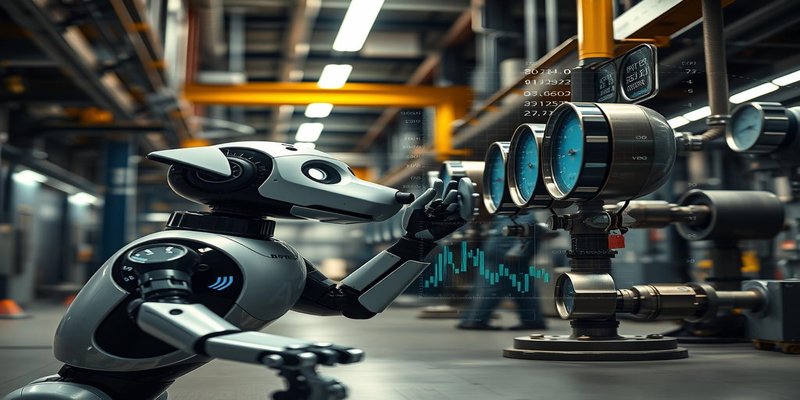
Gemini Robotics-ER 1.6 Transforms Industrial Robot Inspections
Google DeepMind released Gemini Robotics-ER 1.6 on April 14, 2026, a specialized model that significantly enhances spatial and physical reasoning for robotic applications. The headline result: when integrated with Boston Dynamics' Spot robot for industrial inspection tasks, the model boosted analogue gauge-reading accuracy from 23% to 98% — a leap that transforms Spot from a capable patrol robot into a reliable autonomous inspector for industrial facilities.
The partnership between Google DeepMind and Boston Dynamics, announced alongside the model release, makes the Gemini-powered AIVI-Learning system available to all enrolled Boston Dynamics customers as of April 8. For industrial operators managing oil refineries, chemical plants, and manufacturing facilities, Spot can now autonomously navigate inspection routes and read pressure gauges, thermometers, and digital readouts with near-human accuracy.
The Visual Scratchpad: How 86% Became 98%
The key innovation in Gemini Robotics-ER 1.6 is a technique Google calls the "visual scratchpad" — an agentic vision layer that adds an intermediate reasoning step before the model produces its final answer. Without this layer, the same model achieves 86% accuracy on gauge reading. With it, accuracy climbs to 98%.
The visual scratchpad works by allowing the model to point to tick marks, needle positions, and text labels in the image before interpreting them — essentially showing its work, much as a human inspector would trace a gauge needle's position against the scale before recording a reading. This step-by-step visual reasoning approach reduces the errors that occur when models try to jump directly from raw pixels to numerical readings, particularly on analogue instruments with complex scales or partially obscured markings.
Enhanced Spatial Reasoning Across Robotics Tasks
While gauge reading is the most dramatic improvement, Gemini Robotics-ER 1.6 shows significant gains across all spatial reasoning tasks compared to both the previous ER 1.5 and Gemini 3.0 Flash. The model improves performance on pointing accuracy, object counting, and success detection — capabilities that are foundational for any robot operating in unstructured real-world environments.
"Gemini Robotics-ER 1.6 can help robots reason about their surroundings with greater precision, including reading gauges — a capability that has long been one of the hardest for computer vision systems." — Google DeepMind
The improvements are built on top of the broader Gemini model architecture, meaning they benefit from the same scaling and training advances that power Google's consumer-facing Gemini products. This shared infrastructure approach allows Google to amortize its massive AI research investment across both consumer applications and specialized industrial use cases, creating a competitive advantage that pure robotics companies find difficult to match.
Industrial AI Moves From Pilot to Production
The 98% accuracy threshold is significant because it crosses the reliability bar that most industrial operators require before trusting automated systems for safety-critical inspections. Previous AI-powered inspection systems typically achieved 70-85% accuracy, requiring human operators to verify every reading — effectively negating the efficiency gains of automation. At 98%, operators can implement exception-based workflows where humans only review the small percentage of readings that the system flags as uncertain.
Boston Dynamics' Spot already has a significant installed base in industries including oil and gas, utilities, mining, and construction. The addition of reliable AI-powered instrument reading transforms Spot from a data collection platform that still requires extensive human analysis into a semi-autonomous inspection system that can generate actionable reports with minimal human intervention.
What This Means for Engineers and Job Seekers
The convergence of robotics and foundation models is creating demand for a new category of engineer: professionals who can deploy, configure, and maintain AI-powered robotic systems in industrial environments. This requires a blend of traditional industrial engineering knowledge (understanding process equipment, safety protocols, and inspection standards) with modern ML deployment skills. For engineers looking to position themselves for growth, industrial robotics AI is one of the clearest paths from pilot projects to production-scale deployment happening in 2026.
Gemini Robotics-ER 1.6 is available to developers via the Gemini API and Google AI Studio, making it accessible for experimentation and custom application development beyond the Boston Dynamics partnership.