Product Launches
Meta Raises Quest VR Prices Up To $100 as AI Eats RAM Supply
Meta raised Quest 3 and Quest 3S prices by up to $100 starting April 19, directly blaming the ongoing AI-driven RAM crisis that has pushed DDR5 memory costs up over 250% as data centers devour global chip supply.
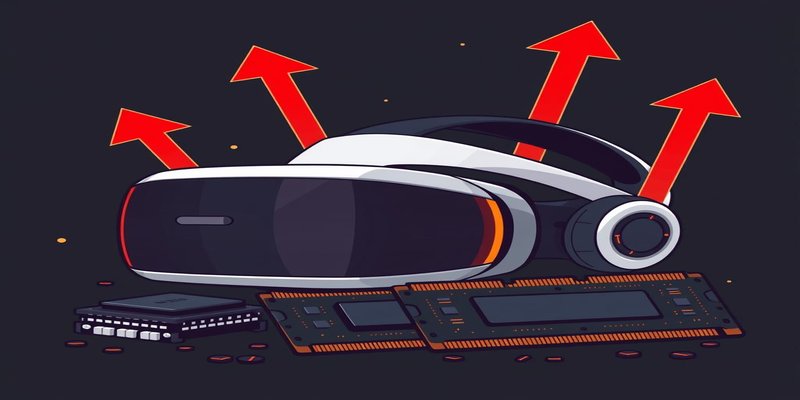
Quest 3 Jumps to $600 as AI Demand Drains Memory Supply
Meta raised prices on its Quest virtual reality headsets starting April 19, 2026, pushing the Quest 3 up $100 to $599.99 and the Quest 3S (128GB) up $50 to $349.99. The Quest 3S 256GB model also climbed $50 to $449.99. Meta directly attributed the price increases to the ongoing AI-driven RAM shortage that has sent memory chip costs surging across the technology industry.
The hikes represent a 20% increase on the Quest 3 and roughly 17% on the Quest 3S — significant price jumps for a product line that Meta had previously positioned as an affordable gateway to virtual reality. The timing is particularly awkward coming just weeks before a planned 8,000-person layoff at Meta and amid questions about the company's commitment to its Reality Labs division.
DDR5 Prices Up 250% in Nine Months
The RAM crisis has been building since mid-2025. DDR5 memory prices surged from $6.84 per unit in September 2025 to $27.20 by December 2025, representing compounded increases of more than 250%. A 32GB DDR5 kit that cost $100 in mid-2025 now costs $350 or more at retail. The primary driver is insatiable demand from AI data centers, which require massive amounts of high-bandwidth memory for training and running large language models.
Meta is not the only company affected. Microsoft raised Surface laptop prices by up to $500 earlier in April citing the same RAM crisis. PC manufacturers across the industry have been absorbing or passing through memory cost increases, with gaming laptops and workstations hit particularly hard. The shortage is expected to persist through at least the second half of 2026 as new memory fabrication capacity comes online.
VR Market Faces a Pricing Problem
The price hikes put Meta's VR strategy in a difficult position. The Quest line's success has been built partly on aggressive pricing — Meta historically subsidized headset costs to build market share and grow its VR ecosystem. Raising the Quest 3 to $600 moves it into territory that competes directly with higher-end headsets from competitors, while the Quest 3S at $350 loses much of the impulse-purchase appeal it had at $300.
"Meta's Quest price hikes just put VR in a worse spot. The company built its VR strategy on affordable hardware, and that foundation is cracking." — Gizmodo
Consumer VR adoption has already been slowing relative to industry projections, and price increases are unlikely to help. The irony is that Meta's own AI infrastructure spending — part of the $115-135 billion the company plans to invest in AI in 2026 — is contributing to the very memory demand that is driving up costs for its VR hardware division.
AI's Hidden Tax on Consumer Electronics
The Quest price hikes are part of a broader pattern of AI infrastructure demand imposing a "hidden tax" on consumer electronics. As hyperscalers — including Meta, Google, Microsoft, and Amazon — compete to build out massive AI data centers, they are buying up global supplies of memory chips, GPUs, and other components, driving up costs for every other product that uses the same components.
This dynamic is particularly visible in DDR5 memory, where data center demand now accounts for over 40% of global production, up from roughly 20% in 2024. Consumer devices — from gaming PCs to VR headsets to smartphones — are competing for the remaining supply at significantly higher prices. Industry analysts expect the situation to ease gradually as Samsung, SK Hynix, and Micron bring new fabrication capacity online, but meaningful price relief is unlikely before Q1 2027.
What This Means for Engineers and Job Seekers
The AI-driven component shortage is reshaping the hardware industry in ways that create new career opportunities. Companies need engineers who understand supply chain optimization, memory architecture, and hardware-software co-design to navigate component constraints. For VR and AR engineers specifically, the slowdown in consumer adoption may shift job opportunities from hardware teams toward enterprise and industrial VR applications, where price sensitivity is lower and the business case for immersive computing remains strong despite higher hardware costs.