Funding & Valuations
Amazon Acquires AI Startup for Warehouse Automation
Amazon has acquired AI logistics startup FleetMind for $1.2 billion, accelerating its push to automate warehouse operations with advanced AI-powered robotics systems.
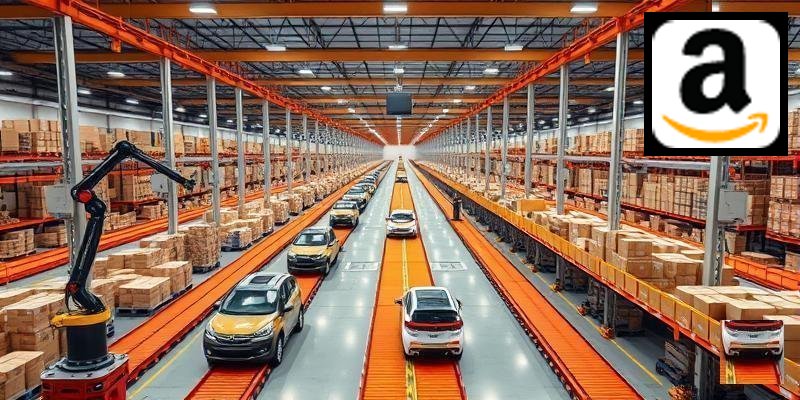
Amazon's $1.2 Billion AI Logistics Bet
Amazon has completed its acquisition of FleetMind, a San Francisco-based AI logistics startup, for approximately $1.2 billion in an all-cash deal. FleetMind specializes in AI-driven warehouse orchestration — using computer vision, reinforcement learning, and multi-agent coordination to optimize the movement of goods through fulfillment centers.
The acquisition is Amazon's largest AI-focused purchase since its $4 billion investment in Anthropic, and signals the company's determination to maintain its logistics dominance through aggressive automation. FleetMind's 340 employees, including 180 AI engineers, will join Amazon's robotics division effective immediately.
"FleetMind's technology represents the next generation of warehouse intelligence. Their multi-agent coordination system can reduce fulfillment time by 40% while improving worker safety." — Amazon VP of Robotics
What FleetMind Built
Founded in 2023 by former Google Brain researchers, FleetMind developed a proprietary AI platform that coordinates hundreds of autonomous robots simultaneously within warehouse environments. Unlike traditional warehouse automation, which relies on fixed routes and predetermined schedules, FleetMind's system uses real-time optimization to dynamically allocate tasks.
Key technical capabilities include:
- Multi-agent reinforcement learning: Robots learn collaborative behaviors that emerge from training, rather than being explicitly programmed
- 3D scene understanding: Computer vision system that maps warehouse environments in real time, detecting obstacles, inventory positions, and human workers
- Predictive demand routing: AI anticipates order patterns and pre-positions inventory before orders are placed
- Human-robot coordination: Safety system that dynamically adjusts robot behavior in zones where human workers are present
FleetMind had previously raised $85 million in Series B funding at a $450 million valuation, making the $1.2 billion acquisition price a nearly 3x return for early investors in just under two years.
Amazon's Broader Automation Strategy
Amazon already operates the world's largest fleet of warehouse robots, with over 750,000 units deployed across its global fulfillment network. The company's existing systems, including the Sparrow pick-and-place robot and the Proteus autonomous mobile robot, handle basic tasks like moving shelving pods and sorting packages.
FleetMind's technology is expected to add a layer of AI intelligence on top of this existing infrastructure, enabling more complex operations like mixed-item picking, quality inspection, and adaptive workflow management. Amazon estimates the integration could reduce per-package handling costs by 25-30% within 18 months.
The financial implications are substantial. Amazon spent $84 billion on fulfillment operations in 2025. Even a 10% efficiency improvement would save over $8 billion annually — far exceeding the acquisition cost.
Job Market Implications
The acquisition raises important questions about the future of warehouse employment. Amazon currently employs approximately 1.5 million people globally, with the majority in fulfillment and logistics roles. While the company insists that automation creates new roles rather than eliminating them, labor economists are skeptical.
"Every major wave of warehouse automation has eventually led to net job reductions, even if new roles are created in the short term. The question isn't whether AI will displace warehouse workers, but how quickly and what alternatives exist." — Labor economics researcher at MIT
On the engineering side, the acquisition is creating significant demand for AI robotics specialists. Amazon has posted over 200 new positions related to the FleetMind integration, with roles in reinforcement learning, computer vision, and robotics systems engineering. For engineers targeting these competitive positions, thorough interview preparation is essential — tools like InterviewAlly can help candidates practice the system design and machine learning interview questions that Amazon's robotics division is known for.
Competitive Landscape in AI Logistics
Amazon's acquisition puts additional pressure on competitors in the e-commerce and logistics space. Walmart has invested heavily in its own automation efforts, partnering with Symbotic for warehouse robotics. Shopify acquired Deliverr for $2.1 billion in 2022 to build out logistics capabilities, and is now exploring AI-driven optimization.
Startups in the AI logistics space are seeing increased investor interest following the FleetMind deal. Companies like Covariant, Locus Robotics, and 6 River Systems (also owned by Amazon subsidiary) are all developing competing technologies, though none have matched FleetMind's multi-agent coordination capabilities at scale.
The deal also highlights a growing trend of large tech companies acquiring AI startups before they can become independent competitors — a pattern that has drawn scrutiny from antitrust regulators in both the U.S. and EU.
Rollout Timeline
Amazon plans to begin deploying FleetMind's technology in 10 pilot fulfillment centers by Q3 2026, with a full global rollout targeted for 2027. The initial deployment will focus on the company's largest facilities in the U.S. and Europe, where the efficiency gains are expected to be most significant.
FleetMind's co-founders will report directly to Amazon's VP of Robotics, and the team will operate as a semi-autonomous unit within Amazon's broader robotics organization. The startup's San Francisco office will be maintained as an AI research hub, with plans to double the engineering team within 12 months.